Gravity and day length: the solar system that defies intuition
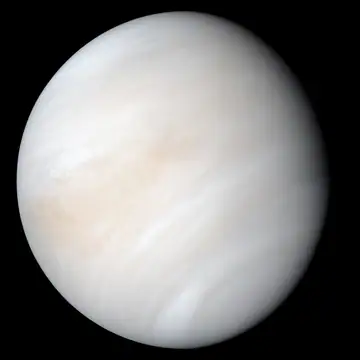
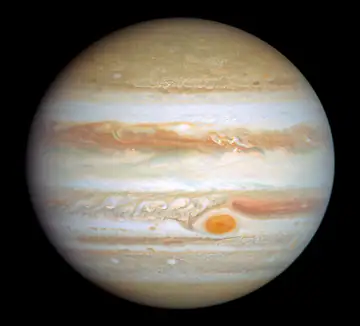
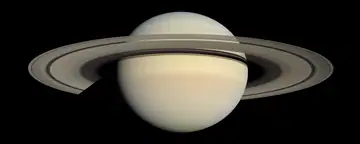
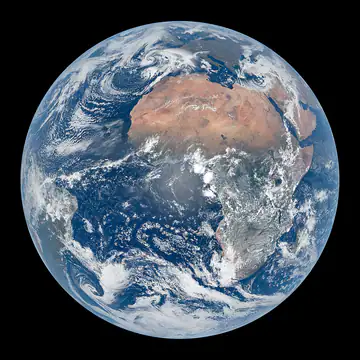
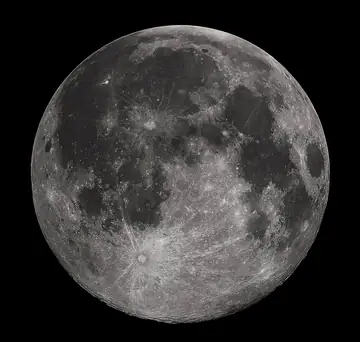
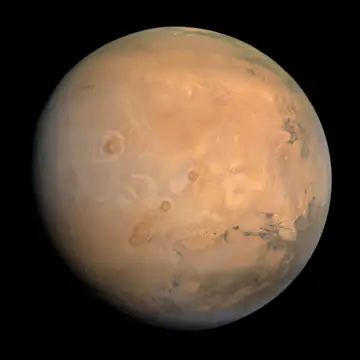
Two space questions in Comparo fool almost everyone: where is gravity stronger? and where is the day longer? In both cases, the size of a body is not enough to guess the answer. Here are the numbers in our database, and the physics behind them.
Surface gravity
| Body | Surface gravity |
|---|---|
| Sun | 274 m/s² |
| Jupiter | 24.8 m/s² |
| Neptune | 11.2 m/s² |
| Saturn | 10.4 m/s² |
| Earth | 9.81 m/s² |
| Venus | 8.87 m/s² |
| Uranus | 8.69 m/s² |
| Mars | 3.72 m/s² |
| Mercury | 3.7 m/s² |
| Moon | 1.62 m/s² |
| Pluto | 0.62 m/s² |
On Earth, a falling object gains about 9.81 m/s of speed every second. On the Moon, six times less: that is why the Apollo astronauts could make big leaps.
The Saturn and Uranus trap
Saturn is nearly 100 times more massive than Earth, yet its surface gravity (10.4 m/s²) is only slightly stronger than ours. Uranus (8.69 m/s²) even has weaker gravity than Earth, although it is much bigger.
The explanation: surface gravity depends on mass, but also on radius. The further you are from the centre, the weaker the pull. Gas giants are so voluminous that their “surface” (in practice, the level where atmospheric pressure equals Earth’s) is very far from their centre. Saturn is also very low in density: in theory, it would float in a big enough bathtub.
Mars and Mercury, almost tied
Mercury is clearly smaller than Mars, yet their gravities are almost identical (3.7 versus 3.72 m/s²). Mercury has a huge iron core, which makes it very dense: its mass makes up for its small size. In the game, these two planets are never pitted against each other on gravity, the gap being too small.
Day length: from 4 hours to 243 days
Here we mean the sidereal day, the time a body takes to spin once on its axis.
| Body | One rotation |
|---|---|
| Venus | 243 days |
| Mercury | 58.7 days |
| Moon | 27.3 days |
| Sun | 25.4 days (at the equator) |
| Mars | 24.6 hours |
| Earth | 23.9 hours |
| Uranus | 17.2 hours |
| Neptune | 16.1 hours |
| Saturn | 10.7 hours |
| Jupiter | 9.93 hours |
| Haumea | 3.92 hours |
Venus, where the day outlasts the year
Venus spins once in 243 Earth days but orbits the Sun in about 225 days: its sidereal day is longer than its year. It also spins in the opposite direction to most planets. The origin of this slow, retrograde rotation is still debated.
The giants spin very fast
Despite their colossal size, Jupiter (under 10 hours) and Saturn (10.7 hours) have the shortest days of the planets. This rapid spin visibly flattens them at the poles. The record in our database goes to Haumea, a dwarf planet in the Kuiper belt, which turns in under 4 hours and has taken on an elongated shape.
“Locked” moons
Many moons in our database carry the note “tidally locked”: they take as long to spin on their axis as to orbit their planet. That is why the Moon always shows the same face to Earth, and why its day lasts 27.3 days.
How to win these duels
- Gravity: the Sun and Jupiter crush everything; after that, the gaps are small between Neptune, Saturn, Earth, Venus and Uranus.
- A giant is not necessarily “heavier” at its surface: think about the radius.
- Day length: giants = short days; Venus and Mercury = endless days.
Where the numbers come from
Values come from the space agencies’ reference fact sheets (NASA in particular). See our method and our article on solar system sizes.